Voice-based, AI-generated pathology reporting
Techcyte Fusion
Active listening reporting on Fusion with elea

The partnership
eleaDNAi
Fusion AP integrates with eleaDNAi, an AI-native assistant built specifically for pathology that goes beyond conventional transcription.
Talk through your assessment, and eleaDNAi turns it into a structured, coded pathology report, right inside the Fusion case view. It understands the context of the case, not just the words.
Elea also builds elea Lab, an AI-powered pathology operating system, a modern LIS that unifies lab hardware and data and connects partner labs and hospitals. Fusion and elea Lab are coming together soon, giving private pathology practices the most integrated LIS and digital pathology platform available.
How it works
Create reports faster
1. Listens
Speak directly in Fusion, in your natural language.
2. Structures
DNAi reads the language in full case context and fills the fields.
3. Generates report
Microscopy and diagnosis are populated, coded to ICD-10, CPT, and CAP synoptic reporting template standards.
4. Sign & send
The pathologist reviews the report, then signs and sends it.


See elea in action in Techcyte Fusion®

From findings to final report
Synoptic reports, done as you dictate
The instant you finish dictating, elea drafts a complete synoptic report, pulling diagnosis, staging, and molecular recommendations straight from your findings. Review it, then sign.
A normal breast resection could be reduced to 5 min with eleaDNAi

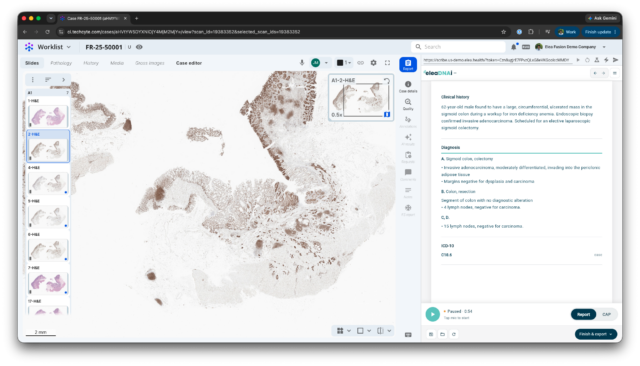
Stay in context
Dictate the full report live, in natural language, while you’re still reviewing the slide. No breaking focus to switch windows or fill in forms.
Click the arrow to learn about other features
Stay immersed
elea captures and organizes what you say in real time, so you stay in the case, not juggling forms.
Click the arrow to learn about other features
No more looking up codes
elea extracts and structures the report as you talk, and assigns ICD-10 and CPT codes directly, no manual lookups.
Click the arrow to learn about other features
0 / 03

Bring your workflow with you
Import your existing templates, macros, and dot phrases, and use them from day one.
Click the arrow to learn about other features
Trigger by voice or by typing
Your shortcuts still work, spoken or typed. Your lab keeps its own reporting conventions, nothing to relearn.
Click the arrow to learn about other features
0 / 02
-
Sebastian Casu, MD, Co-Founder & Chief Growth Officer, elea
“eleaDNAi transforms the pathologist’s assessment into a structured report while keeping the focus on the case and control firmly with the pathologist. Together with Techcyte, we are bringing eleaDNAi to more laboratories as part of an open pathology ecosystem.” -
Ben Cahoon, Techcyte CEO
“Pathology ultimately comes down to the diagnosis, and technology should make that moment easier, not more complicated. By bringing elea’s AI-based reporting capabilities into Techcyte Fusion, we can further reduce workflow friction and keep the pathologist focused on the case in front of them.”